Abstract
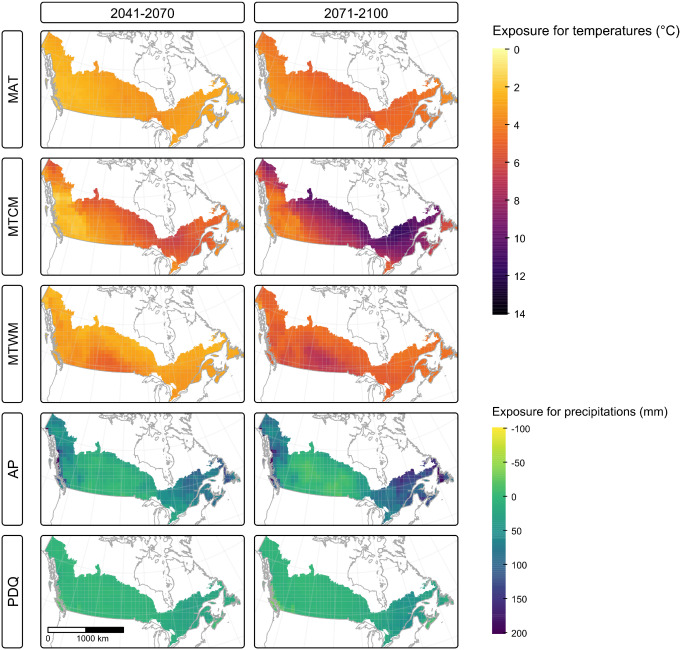
Understanding tree species’ responses to climate change is essential for forest management. A key challenge is assessing species vulnerability and identifying those capable of persisting and thrive under future climates. Traditional correlative approaches using species distribution and climate envelopes project climates where species currently occur but cannot distinguish physiological tolerances from dispersal limitations or biotic interactions. This study differs by quantifying climatic niches—the physiological tolerances of 313 North American tree species—using comprehensive worldwide occurrence datasets. Specifically, we: (1) identified Canadian regions with high climatic exposure; (2) determined species sensitivity based on climatic safety margins; and (3) identified candidates for assisted migration using climate analogues. Our results show that many species already exceed their thermal tolerance limits—45 % for maximum temperature of the warmest month, and 100 % for minimum temperature of the coldest month, reflecting range limits rather than immediate climatic stress. Although an average of 30 species may remain suitable under future climate scenarios, ‘no-analogue’ climates limit assisted migration potential across Canada. Moreover, species new to Canadian regions that become climatically suitable in the future currently face cold extremes as a climate bottleneck. Ultimately, only four to 13 species, depending on climate scenario and species niche, are projected to tolerate both baseline and future climates. These findings enhance understanding of forest resilience under climate change, directly informing vulnerability assessments and adaptive management strategies.
https://doi.org/10.1016/j.ecochg.2026.100114