
DIVERSE: Implementing the Functional Complex Network Approach Alongside Climate-Smart Forestry in Canada

DIVERSE: Implementing the Functional Complex Network Approach Alongside Climate-Smart Forestry in Canada

by Kevin A. Solarik, Morgane Dendoncker, Isabelle Aubin, Olivier Villemaire-Côté, Marie-Josée Fortin, Harry Nelson, Nelson Thiffault, Bradley D. Pinno, Madeleine Gauthier, Kathryn Knodel, Charles A. Nock, Clément Hardy , Andreas Hamann , Élise Filotas, Matthew Garcia, Hugh Scorah, Robert E. Froese, Douglas R. Turner, Fangliang He, F. Wayne Bell, Yan Boulanger, Jesus Pascual Puigdevall, Stephen J. Mayor, Kevin Webber, Keri Ardell, Lance W. Robinson, James W. N. Steenberg, Jean-François Bissonnette, Brian R. Sturtevant, Peter N. Duinker, Kirsten Vice, Peter B. Reich, and Christian Messier

You may access the full paper by clicking on the figure on the left

Abstract

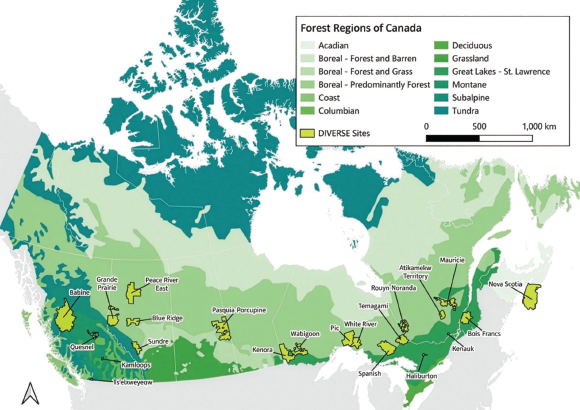
Canada’s forest sector must maintain wood supply, carbon storage, biodiversity, and social values as climate change and other global stressors increase the risk of disturbance and threaten forest resilience. Climate-Smart Forestry (CSF) offers an important framework for integrating adaptation, mitigation, and socio-economic objectives, but practitioners often lack spatial decision support tools that connect stand-level actions to landscape-scale resilience under uncertain future conditions. We introduce DIVERSE, a pan-Canadian research partnership working across 22 managed-forest landscapes (>20 Mha) to implement and test the Functional Complex Network (FCN) approach as a spatially explicit, resilience-oriented planning method aligned with CSF. FCN represents landscapes as networks of stands and combines functional trait diversity and redundancy with network properties, including connectivity, centrality, and modularity, to identify where diversification, conservation, or spatial reconfiguration can enhance resilience while limiting ecosystem-wide risk. We summarize DIVERSE’s six integrated research themes and operational products: (1) vulnerability and trait baselines; (2) climate-adaptation guidance for species and seed sources; (3) FCN-based resilience assessment and prioritization; (4) climate and management scenario testing through landscape simulation; (5) socio-economic feasibility analyses; and (6) operational field experiments. DIVERSE will evaluate where and when FCN can improve the robustness of forest management in Canada and support the long-term sustainability of future Canadian forests.
doi.org/10.5558/tfc2026-022
EN