
22
Sites across Canada
Summary from: Boyce, Hamann, Dorrell, & Nielsen (2026). “Prioritizing Conservation of Trailing-Edge Populations for Future Climate-Resilient Forests,” Global Change Biology.
Imagine a population of spruce or maple trees that has grown for generations in the hottest or driest place where its species can still survive. These populations, known as “rear-edge” populations, often carry genetic adaptations shaped by living at the edge of what their species can tolerate — things like greater drought tolerance or heat resistance. As the climate warms, larger portions of a species’ range are starting to resemble the conditions these edge populations already know. That makes their genes potentially valuable: a natural head start for helping forests adapt elsewhere.
The problem is that some of these populations are at risk of disappearing first as a result of climate change. These rear-edge populations that are threatened by climate change are called trailing-edge populations. A team from the University of Alberta from the DIVERSE research project set out to answer a crucial question: where are these trailing-edge populations located in North America, and where could they be relocated to preserve their genetic heritage?
The researchers analyzed the 100 most common tree species on the continent to identify the trailing-edge populations. By cross-referencing historical and projected climate data with forest inventories from Canada and the United States, they successfully found populations that will experience climates beyond the historic range limits of their species by the 2050s.
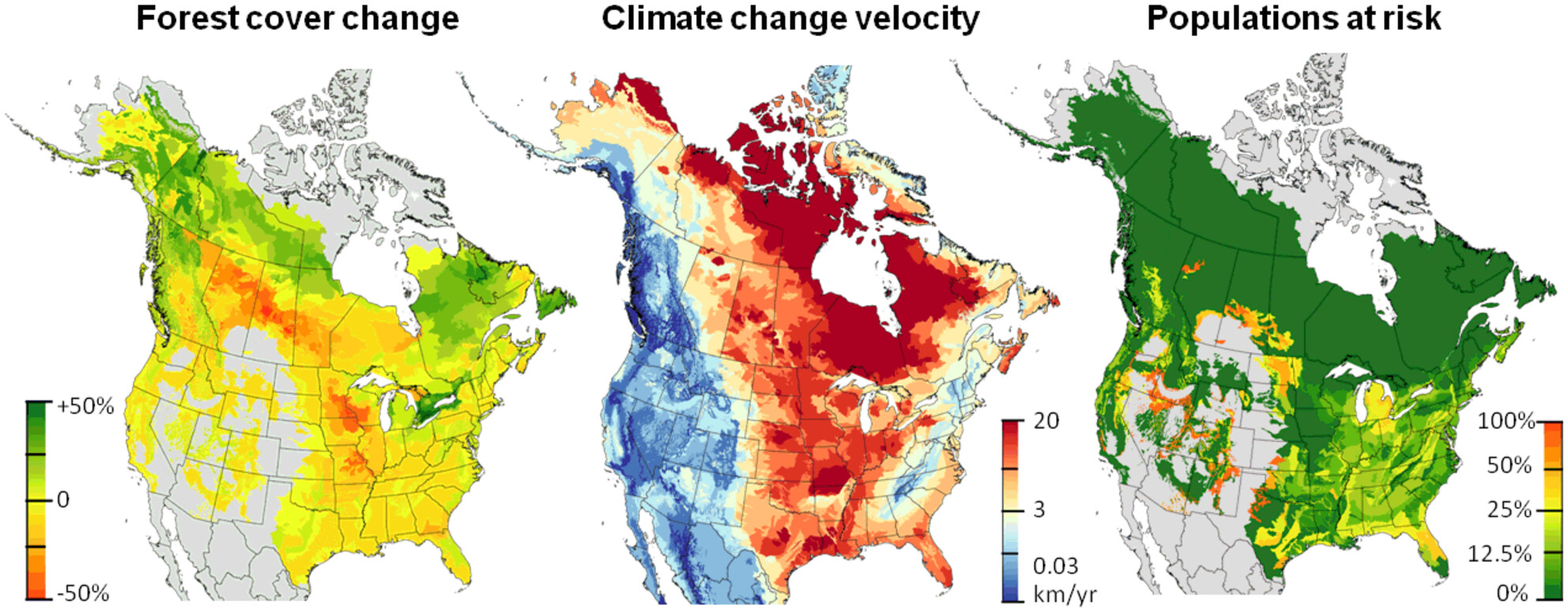
Gene conservation priorities should be directed toward the flatter landscapes of the Midwest and southwestern boreal forest, where researchers identified high climate velocity and high relative forest cover loss.
Because they are regions with a high diversity of species, the Appalachians and the Great Lakes region have the highest concentration of at-risk populations.
The areas bordering the central prairies (southwestern boreal zone, western margins of the Eastern temperate forests) face the greatest loss of forest habitat and the farthest movements required to keep pace with climate change (climate velocity); this is where human intervention will likely be most necessary, as natural migration will not keep pace.
The Great Lakes basin and eastern Canada—including southern Ontario, the northern Appalachians, and New Brunswick—stand out as promising climate refuges—places where the future climate will resemble the historical habitat of many threatened populations.
Interestingly, the regions with the highest concentration of at-risk populations (the Appalachians, the Great Lakes) are not necessarily those where the climate threat is most urgent. Many vulnerable populations in these regions will be able to migrate short distances by moving to higher elevations rather than going extinct.
To make these results usable in the field, the team developed a free online tool, the Protected Area Selection Tool for North America (PAST-NAm). It allows anyone planning a seed collection or an assisted migration project to identify protected areas whose future climate will match the current habitat of a given population.
Three prioritization criteria. The study combines:
(1) the projected loss of climate-appropriate forest habitat, an indicator of the risk of local extirpation;
(2) the velocity of climate change, which indicates whether natural dispersal will suffice or whether human intervention will be necessary; and
(3) the number of at-risk populations per ecosystem, which reflects conservation value.
Supplementary Tables S1 and S2 provide priorities by species and by ecosystem, which is a good starting point for targeting a region of interest.
Limitations of the tool to be aware of before using it. The tool assumes that ecosystem boundaries closely follow climate and vegetation community composition. This is a sound assumption on flat terrain, but less so in mountainous areas, where climate gradients are steep, and microclimates are fragmented. Practitioners should treat migration recommendations as general guidelines to be validated with local knowledge of the terrain, not as firm prescriptions.
The discrepancy between observed and projected climate. Projections use 30-year averages (the 1960s and 1990s for historical data; the 2020s, 2050s, and 2080s for the future). If the observed warming at your site already exceeds model projections, it may be justified to shift the time horizon used forward (for example, consult projections for the 2080s rather than the 2050s) for a more proactive migration strategy. Conversely, if the observed change is lagging behind projections, a more conservative approach is warranted.
What the tool does not do. The tool is based on large-scale climate matching. It does not consider disturbance regimes, the availability of wetlands or riparian habitats, or the companion species necessary for establishment. For rare species or those specialized to a particular habitat, seed collection guided by PAST-NAm must be supplemented by a field assessment and local silvicultural knowledge.
A risk that should not be overlooked. Introducing genetic material outside its native context carries risks: outbreeding depression, loss of local adaptation, or disruption of existing ecological interactions. The authors recommend prioritizing climatic and ecological affinity (soil type, shared disturbance regime) and, whenever possible, conducting trials in common gardens before large-scale deployment.
This study does not tell us where to plant trees tomorrow morning. It rather provides a continent-wide prioritization map, a scientific starting point to guide in situ conservation and assisted migration efforts.
For practitioners considering seed collection in anticipation of future climate conditions, PAST-NAm (accessible via https://tinyurl.com/past-nam) is a valuable decision-making tool, provided its limitations are kept in mind and it is combined with on-the-ground judgment.
For the full paper, you may consult the link here: https://doi.org/10.1111/gcb.70971