
22
Sites across Canada
Summary of: Isabelle Aubin, Amanda Roe, Benjamin Marquis, Laura Boisvert-Marsh, John Pedlar, Sandy Erni, Benoit Hamel, Glenn Lawrence, Dan McKenney, and Taylor Scarr (2026). “Vulnerability of Canadian Forests to Invasive Insects under Climate Change,” Canadian Journal of Forest Research.
The mountain pine beetle, the emerald ash borer, the hemlock woolly adelgid… the list of invasive insects threatening Canadian forests is growing, as international trade facilitates long-distance invasions and climate change accelerates their northward spread. Until now, most risk assessments have been conducted on a species-by-species basis. A team from Natural Resources Canada wanted to take a step back and produce and integrated national picture: how vulnerable are Canada’s forests to high-risk invasive insects?
The researchers produced vulnerability maps by cross-referencing the distribution of 37 of Canada’s most abundant tree species with the current and projected climatic niches of 14 high-risk invasive insects along with the severity of the damage they cause.
The picture is striking: 3.2 billion metric tons of forest biomass are currently at risk of exposure to at least one of the 14 targeted insects. This figure could rise to 13.6 billion metric tons within 20 years, depending on the insects’ ability to spread, favored by the northward expansion of suitable climatic habitats.
Two hotspots stand out, and they are very different in nature:
In Western Canada, the mountain pine beetle currently threatens 804 million metric tons of pine trees outside its historical range. Here, the vulnerability stems primarily from a single, highly destructive species.
In Eastern Canada, several insects are simultaneously threatening companion species: ash trees, American beech, and Canadian hemlock. Individually, each of these tree species represents a relatively small amount of exposed biomass, but outbreaks of these pests are severe and cause significant mortality. One of their main consequences is a reduction in the functional redundancy of forests and a narrowing of the range of native tree species.
Notable fact: The central boreal forest remains, for now, a relatively unaffected area, partly due to cold temperatures and antagonistic interactions with native insects. However, global warming could increase the risk of insect outbreaks in the future.
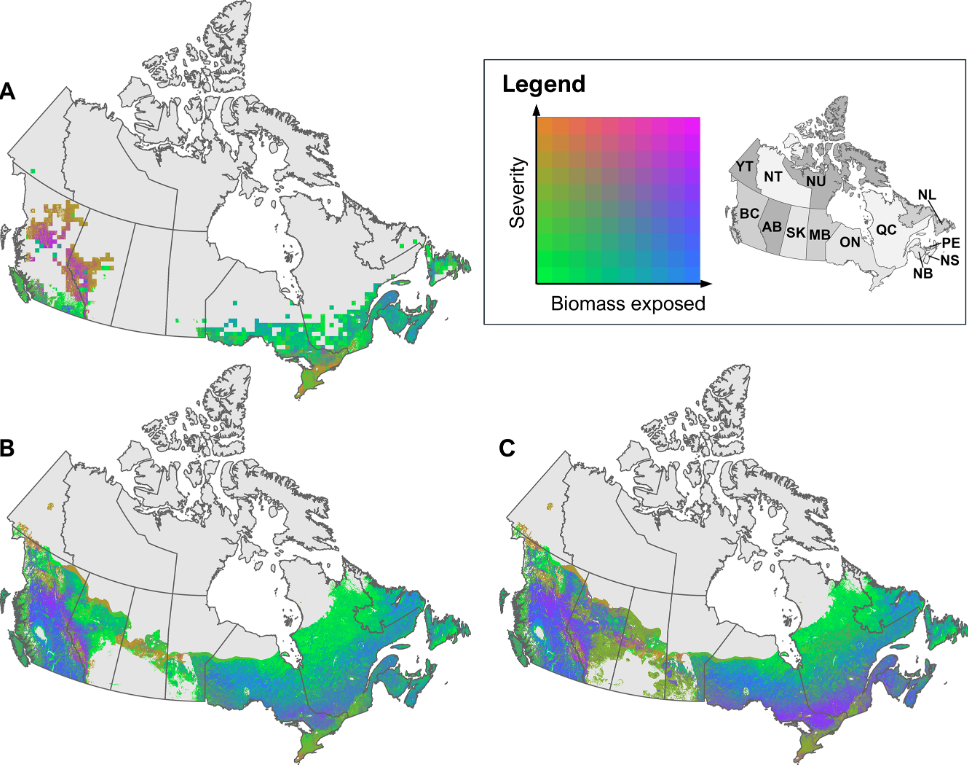
Certain tree species are at much greater risk than others. Black spruce is the most exposed species in absolute volume (875 Mt currently at low-severity risk), but red spruce stands out for its high exposure: 95% of its biomass nationwide is already at risk. Conversely, five tree species in Western Canada and several genera in the East—maples, poplars, Douglas firs, and cedars—are not exposed to any of the 14 targeted insects (excluding the Asian longhorned beetle).
A scenario to monitor closely: the Asian longhorned beetle (ALB). This pest has been successfully eradicated twice in Ontario, but the risk of reintroduction remains high, as active infestations continue in the United States. If it were to re-establish itself, six additional tree species (maples, birches, poplars) would become vulnerable, adding 3.1 billion metric tons of exposed biomass—a 23% increase in the country’s total vulnerability. The authors note that the two eradication programs cost a total of approximately 35.5 million Canadian dollars, whereas an unmanaged invasion could cost more than 431 million Canadian dollars per year in timber products alone. Early detection remains by far the most cost-effective option.
The severity rating: a useful prioritization tool. The study uses a 6-level severity scale (adapted from Mech et al. 2019), ranging from the mortality of already weakened trees (level 1) to the potential for functional extinction of the host species (level 6). Both the emerald ash borer and the hemlock woolly adelgid are classified at the highest level—a clear signal to prioritize monitoring of these two pests wherever their hosts are present.
Impacts may be underestimated even at low severity levels. The authors emphasize that a severity-level-1 infestation (mortality of stressed trees only) can still significantly alter the structure and productivity of a stand: weakened but living trees lose their functional role in the ecosystem for years before dying. Therefore, one should not rely solely on the severity rating to assess the urgency of intervention. These infestations occur in a context where forests are already weakened by droughts, extreme weather events, and climate change. These conditions weaken trees and promote the proliferation of these pests.
Limitations of the analysis to keep in mind. This assessment does not model either the actual spread of insects or the cumulative effects of combined disturbances (such as drought and insects). Vulnerability maps should therefore be viewed as a starting point for targeting monitoring efforts, not as a precise prediction of where and when an infestation will occur.
This national overview provides a practical tool for prioritization: it allows for the rapid identification of regions where monitoring should be intensified, where early-detection efforts should be concentrated, and where tree species composition warrants review based on future invasion risks. In a context where intervention is not possible everywhere, this overview helps determine where to act first.
For the full paper, you may consult the link here: https://doi.org/10.1139/cjfr-2025-0328