
22
Sites across Canada
Some researchers find their calling in a classroom. Others, like Sebastián Guerrero, find it in the forest itself.
Born and raised near Popayán, a city tucked into Colombia’s Andes Mountains, Guerrero’s childhood unfolded on a family farm bordered by the Tropical Andes Biodiversity Hotspot and, strikingly, by monospecific forest plantations from one of the country’s largest forestry projects.
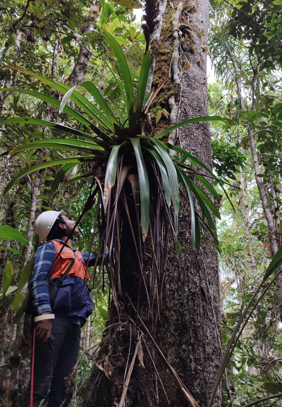
“I would say that I was born in the middle of forests,” he recalls. His home province, Cauca, sits between the Amazon and the Chocó-Darién, two of South America’s largest tropical rainforests. “That means a lot of forests to be seen.”
That early proximity to nature planted more than curiosity; it planted a question. “I spent much of my childhood in these ecosystems, observing the plants and the trees much more closely and wondering how and why all those species were all growing together.”
Finding a Field
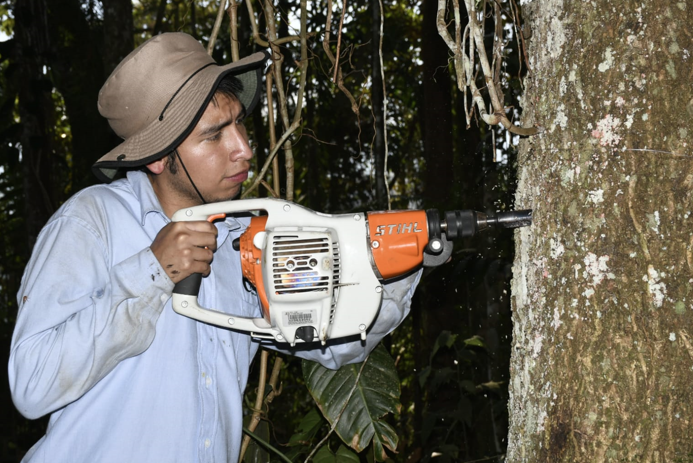
That childhood wonder eventually pointed toward a discipline: forestry engineering, which he studied at the University of Cauca. There, Guerrero joined – and later coordinated – the Seedbed for Applied Silviculture. This student-led research group opens the door to hands-on fieldwork, from characterizing Andean forests to supporting conservation efforts for the endangered black oak (Trigonobalanus excelsa) in the Colombian Massif.
Sebastian later pursued an internship with Smurfit Westrock Colombia, estimating biomass in monospecific Pine and Eucalyptus plantations. Then came an international opportunity: a scholarship through the Pacific Alliance’s Student and Academic Mobility Platform. This brought him to Chile, working across the Mediterranean forests of central Chile and the Valdivian rainforest, both globally recognized biodiversity hotspots.
It was this back-and-forth between vastly different forest systems that crystallized the question still driving his research today:
“How do biodiversity and ecosystem functioning influence each other? A better understanding of this relationship could enhance forest productivity and resilience to environmental disturbances, which is key in the context of global change.”
Arriving at DIVERSE
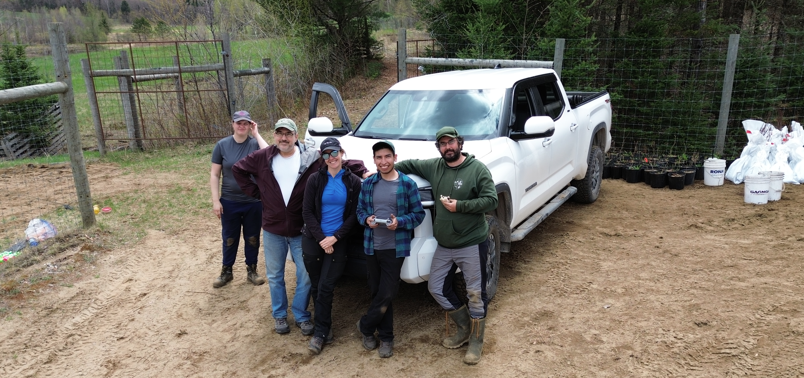
That question eventually led to a connection with Christian Messier and the start of a Master’s in Biology at UQAM in 2024.
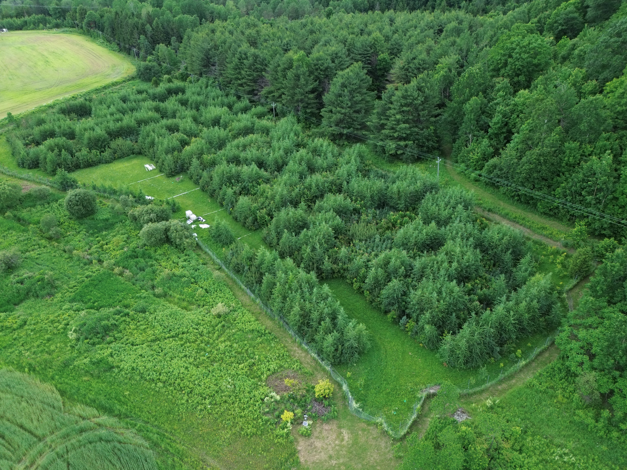
Sebastian’s research for his Master’s took place at the IDENT Outaouais experimental plantation, where the research team was examining how species diversity and horizontal heterogeneity (the distribution of the trees within a stand) shape the productivity of young tree communities. It’s often been observed that greater species diversity boosts forest productivity and other ecosystem functions. However, the relationship between diversity and horizontal heterogeneity, and its role in ecosystem functioning, has received little attention.
To dig into this, Sebastian drew on five years of growth data from four tree species. Each species was planted as monocultures and in two- and four-species mixtures, arranged in distinct spatial patterns:
Regular: trees planted in traditional monoculture rows
Complex: species arranged according to shade tolerance, mimicking the self-organization seen in early forest succession
Random: a random point distribution with the same average tree spacing as the complex pattern, but with no regard for species’ light needs
“This experimental design will provide valuable knowledge about how to distribute the tree species when establishing new forests to enhance positive diversity effects,” he explained.
What the Data Is Already Saying
Even at this stage, clear patterns are emerging:
“We have learned that young forests do not play dice,” Sebastian says. In other words, mixing species at random, without regard for their light requirements, can backfire; reducing rather than boosting productivity.
The flip side, though, is encouraging: “Increasing the number of species with contrasting light requirements and planting them according to those requirements, as in our complex pattern, may enhance complementarity effects on productivity.”
Looking Toward the PhD
With the Master’s drawing toward its next phase, plans are already forming for a PhD. The focus will shift belowground to root processes that are increasingly recognized as central to how ecosystems function.
Another ambition is also taking shape: tapping into two decades of data from TreeDivNet, the world’s largest network of tree diversity experiments, Sebastian wants to help inform how DIVERSE could design strategies for diversifying forests across Canada.
Asked about the best part of being part of DIVERSE, Sebastian did not talk about trees at all — but about the people:
“Being a member of DIVERSE and meeting great researchers like Jürgen Bauhus and Peter Reich whose papers I have read since the beginning of my career, and my colleagues, the DIVERSE students, who are developing amazing projects and ideas has been also very inspiring.”
That exchange of ideas has left a mark on how he approaches science itself: “Working with DIVERSE has actually changed the way I work, introducing me to the concept of complexity, for example.”
And the influence, he hopes, won’t stop at Canada’s borders. “I would be very happy to bring these ideas and values from DIVERSE to my tropical home, where they would be very relevant and useful.”