
22
Sites à travers le Canada
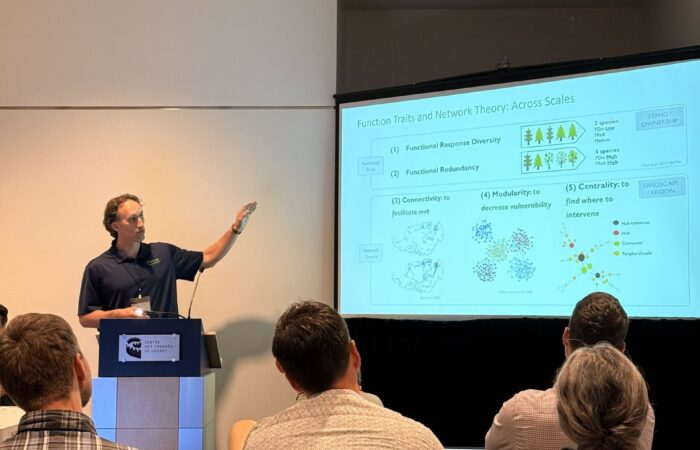
Résumé tiré de : Solarik et al. (2026). « DIVERSE: Implementing the Functional Complex Network Approach Alongside Climate-Smart Forestry in Canada », présenté lors de la conférence CIF-IFC 2025.
Depuis les années 1990, la gestion durable des forêts au Canada s’efforce de concilier l’approvisionnement en bois, le stockage du carbone, la conservation de la biodiversité, les services écosystémiques, les valeurs sociales, ainsi que les droits et intérêts des peuples autochtones. Cependant, les changements globaux accentuent la fréquence, la gravité et l’imprévisibilité des sécheresses, des feux de forêt, des infestations d’insectes et d’autres perturbations. Par conséquent, les arbres plantés aujourd’hui doivent survivre et pousser pendant des décennies dans des conditions climatiques et écologiques de plus en plus incertaines.
Le projet DIVERSE a été lancé pour relever ce défi. Ce partenariat de recherche pancanadien rassemble plus de quarante chercheurs, sept universités et de nombreux partenaires issus des secteurs forestier, gouvernemental et autochtone. Son objectif est de tester une nouvelle approche visant à renforcer les forêts grâce aux réseaux fonctionnels complexes (FCN), laquelle est mise en œuvre dans 22 paysages forestiers répartis dans six provinces, couvrant plus de 20 millions d'hectares.
De nombreuses stratégies d'adaptation des forêts se concentrent sur les peuplements individuels : quelles espèces faut-il planter ? Quelle provenance de semences faut-il choisir ? Comment modifier la composition ou la structure du peuplement ?
L'approche FCN élargit cette perspective en considérant le paysage forestier comme un réseau. Chaque peuplement est considéré comme un nœud relié à ses voisins par des processus écologiques, notamment le déplacement et la dispersion potentiels des graines. Cette perspective de réseau met en avant cinq propriétés importantes pour évaluer la résilience du paysage :
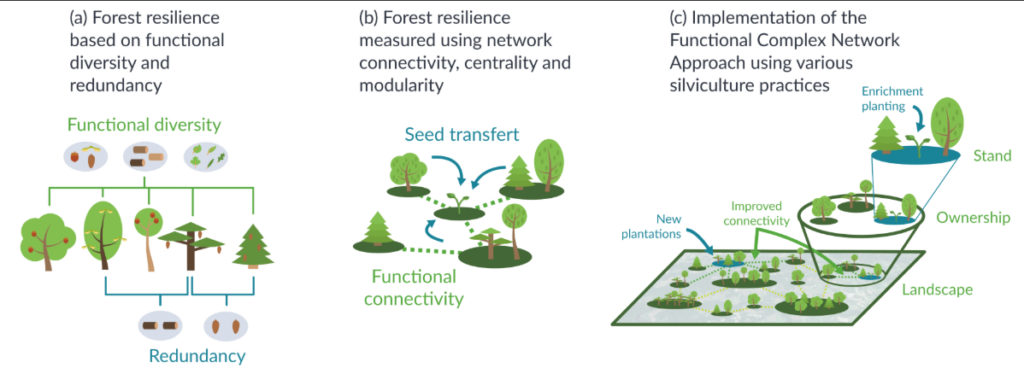
Le projet DIVERSE s'articule autour de six thèmes interdépendants, allant de l'évaluation et de la planification à la mise en œuvre et à l'apprentissage opérationnel.
Thème 1 — Vulnérabilité des forêts : Élaborer des indices décrivant la sensibilité des espèces à la sécheresse, à l'échec de la migration, aux feux de forêt et à l'échec de la régénération, à partir des informations sur les traits fonctionnels de 77 espèces d'arbres canadiennes.
Thème 2 — Identification des espèces forestières adaptées et des sources de semences : Identifier les espèces d'arbres et les provenances de graines susceptibles d'être les mieux adaptées aux conditions climatiques actuelles et futures dans chaque région.
Thème 3 — Réseaux fonctionnels complexes: Calculer les caractéristiques du FCN pour chaque site d'étude et cartographier les priorités d'intervention.
Thème 4 — Test de scénarios à l'aide de modèles de simulation des paysages forestiers : Comparer les stratégies « statu quo » (BAU), de sylviculture adaptée au changement climatique (CSF) et FCN à l'aide du modèle LANDIS-II, sur des horizons temporels pouvant aller jusqu'à 200 ans.
Thème 5 — Faisabilité socio-économique, gouvernance et voies de mise en œuvre : Évaluer les coûts, les contraintes opérationnelles, les exigences en matière de gouvernance et les conditions susceptibles d'influencer la faisabilité et l'acceptabilité sociale des différentes stratégies de gestion.
Thème 6 — Expériences sur le terrain et apprentissage opérationnel : Mettre en place des sites de démonstration opérationnels afin de tester les traitements sylvicoles retenus dans le cadre des thèmes précédents et d'évaluer leur mise en œuvre dans des conditions réelles.
Un cadre permettant de répondre à trois questions concrètes :
L'approche FCN est conçue pour exploiter des informations déjà couramment disponibles dans le secteur forestier ou pouvant être obtenues assez facilement. Il peut s'agir notamment de données d'inventaire forestier, de cartes de la végétation et du couvert forestier, d'informations sur les caractéristiques fonctionnelles des espèces locales, ainsi que d'hypothèses réalistes concernant la capacité de dispersion des graines.
Le projet DIVERSE étudie comment ces données peuvent être harmonisées et intégrées dans les processus de planification forestière et les cycles de planification opérationnelle existants.
L'encadré 2 de l'article présente une démarche concrète pour intégrer les résultats du projet DIVERSE dans la planification forestière :
L'approche FCN n'est pas un système sylvicole en soi. À l'instar de la sylviculture adaptée au climat, il s'agit d'un cadre décisionnel pouvant orienter toute une série de mesures de gestion.
En fonction des objectifs et des conditions locales, ces mesures peuvent notamment inclure :
La combinaison d'actions appropriées dépendra du contexte écologique, des objectifs de gestion, des contraintes opérationnelles et des risques de perturbation prévus au sein de chaque paysage.
La connectivité des paysages peut favoriser la régénération forestière en facilitant la dispersion des graines et la recolonisation après une perturbation. Cependant, elle peut également accélérer la propagation des feux de forêt, des infestations d'insectes ou des agents pathogènes lorsqu'elle crée des couloirs continus de combustible ou d'hôtes sensibles. À l'inverse, les paysages excessivement compartimentés peuvent limiter la circulation des graines et ralentir la régénération écologique.
L'approche FCN n'élimine pas ce compromis. Elle fournit au contraire un cadre permettant de l'identifier et de l'évaluer de manière explicite. L'objectif est de maintenir une connectivité fonctionnelle suffisante pour favoriser la régénération, tout en maintenant une modularité suffisante pour réduire le risque de propagation en cascade des perturbations à l'échelle de l'ensemble d'un paysage.
Le projet DIVERSE entre désormais dans sa phase opérationnelle. Les travaux en cours consistent notamment à mener des évaluations de vulnérabilité, à identifier les sites prioritaires pour des interventions fondées sur le FCN, à comparer des stratégies de gestion par le biais de simulations, à évaluer leur faisabilité socio-économique et en matière de gouvernance, et à valider les approches retenues par le biais d'essais opérationnels sur le terrain.
Le projet permettra d'élaborer des cartes de vulnérabilité, des couches de données sur l'adéquation climatique spécifiques à chaque espèce, des cartes FCN, des outils d'aide à la décision et des protocoles de suivi. Ces ressources seront progressivement mises à disposition sur le portail du projet DIVERSE, sous réserve des accords de partage de données conclus avec les partenaires du projet : (https://diverseproject.uqo.ca/)
Pour consulter l'article dans son intégralité, cliquez sur le lien suivant : doi.org/10.5558/tfc2026-022